SoCEE Graduate Students Earn Top Honors in College of Engineering Poster Competition
SoCEE is proud to celebrate outstanding achievements by its graduate students at the recent College of Engineering Graduate Poster Competition, where students from both Civil Engineering and Environmental Engineering earned recognition at the departmental and college-wide levels.
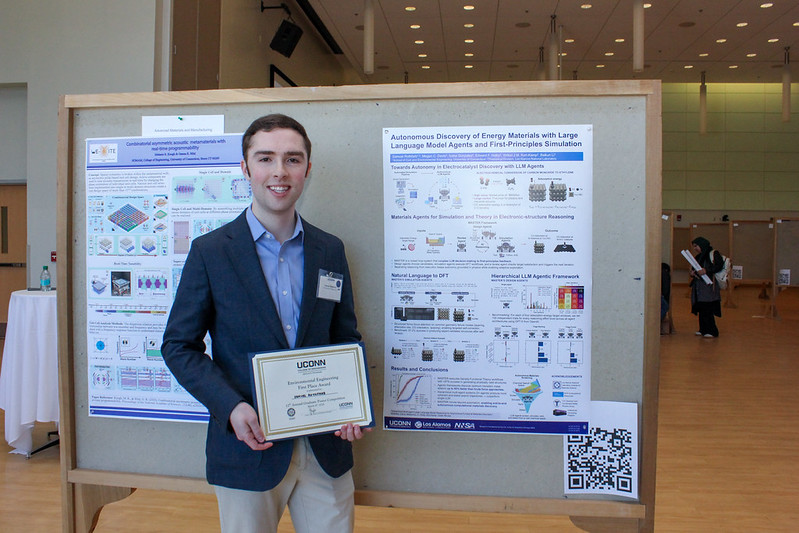
In the first round of judging, Ana Carolina Vieira Rocha and Dahye Kim were selected as departmental winners for the Civil Engineering program, and Samuel Rothfarb was selected as the departmental winner for the Environmental Engineering program. In the final college-wide competition, Rothfarb earned first place overall, and Vieira Rocha earned third place overall, giving SoCEE two of the top three awards across all College of Engineering graduate programs.
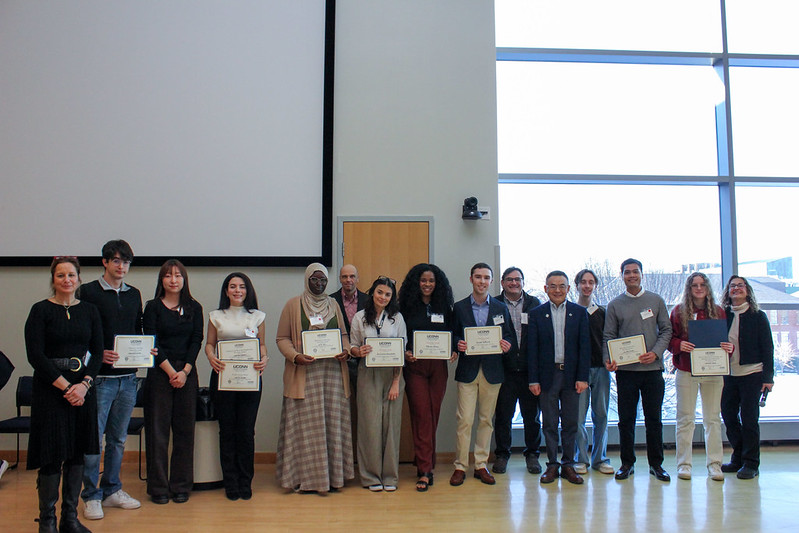
The event highlighted the depth of graduate research taking place across UConn Engineering, while also recognizing students’ ability to clearly communicate complex ideas to a broad audience. For SoCEE, the results reflect excellence across multiple areas of research, from infrastructure durability to transportation optimization and autonomous scientific discovery.
Departmental and College-Wide Recognition
Because of the high number of participants and the strength of the presentations, two students were recognized in the Civil Engineering category during the first round of judging. Vieira Rocha and Kim were both named departmental winners, while Rothfarb advanced from the Environmental Engineering category and ultimately earned the competition’s top overall award. Vieira Rocha’s third-place finish in the final round further underscored the strong showing by SoCEE students in this year’s competition.
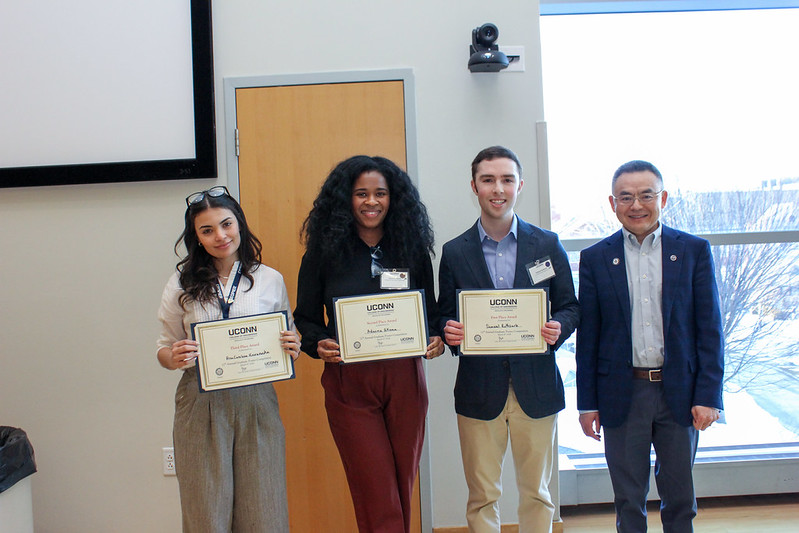
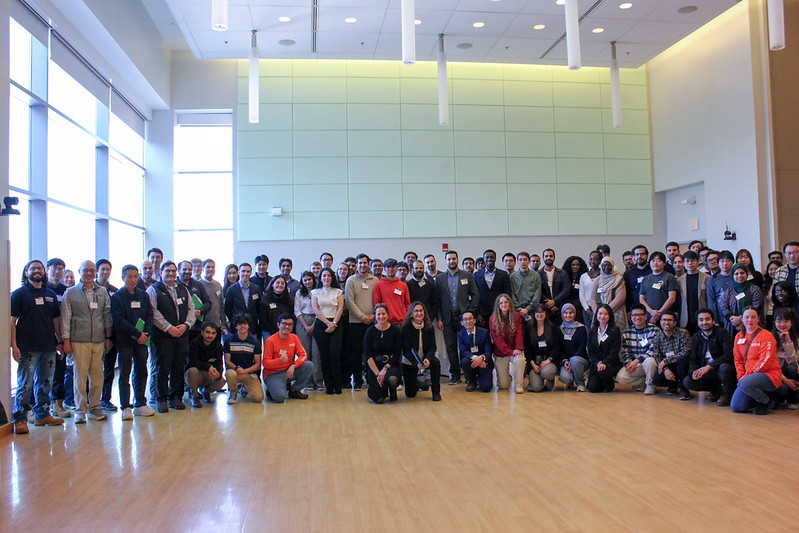
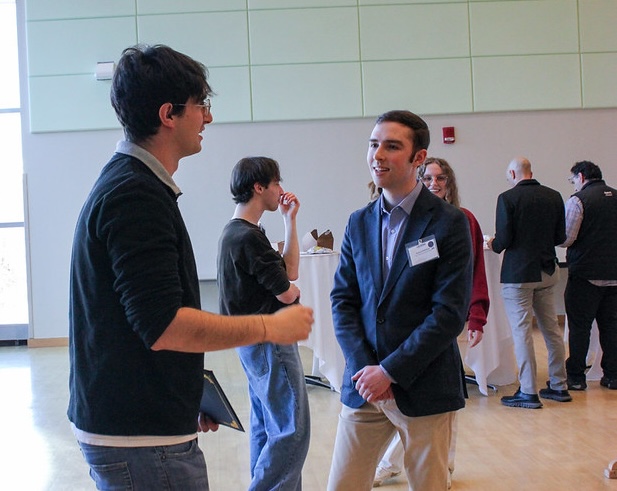
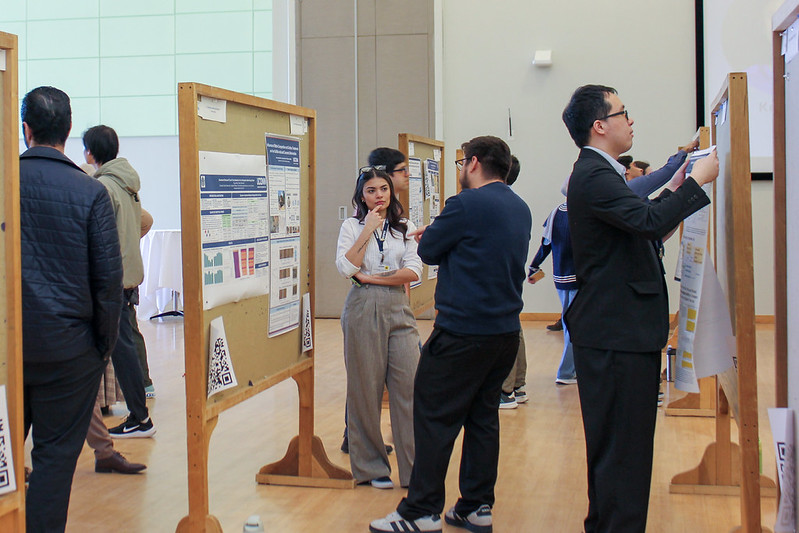
Photos from the event also capture the energy of the competition, including poster presentations, conversations among participants, and the award ceremony itself.
Samuel Rothfarb Earns First Place Overall
Rothfarb’s poster, “Autonomous Discovery of Energy Materials with Large Language Model Agents and First-Principles Simulation,” focused on the growing role of artificial intelligence in scientific discovery. His research introduces Materials Agents for Simulation and Theory in Electronic-structure Reasoning (MASTER), an active learning framework in which large language models autonomously design, execute, and interpret atomistic simulations.
Rather than simply automating routine tasks, the framework is designed to engage in higher-level scientific reasoning. Across two chemistry applications, the system significantly reduced the number of required atomistic simulations compared to conventional trial-and-error selection, helping accelerate materials discovery while also producing reasoning trajectories grounded in chemical principles. The work points toward a new model for autonomous scientific exploration.
Ana Carolina Vieira Rocha Earns Third Place Overall
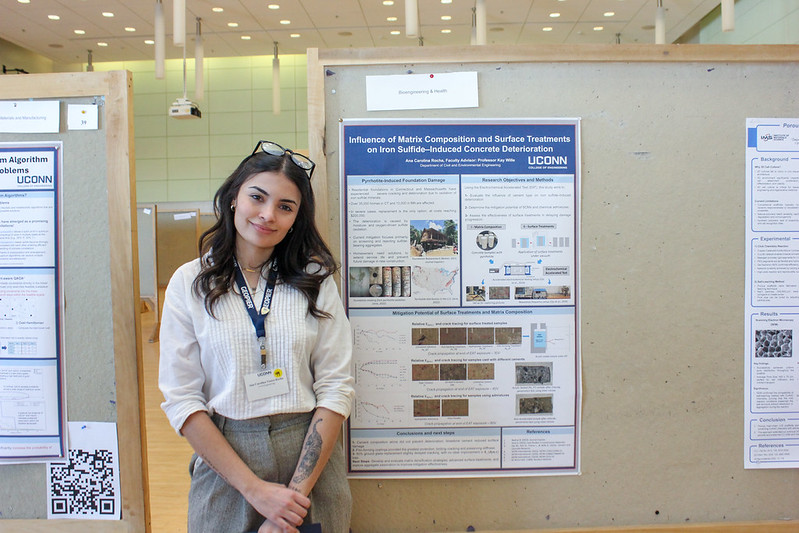
Vieira Rocha’s poster, “Influence of Matrix Composition and Surface Treatments on Iron Sulfide-Induced Concrete Deterioration,” examined a major infrastructure challenge associated with pyrrhotite-bearing aggregates in concrete foundations. Her research explored how both the internal composition of concrete and external surface treatments affect the rate of oxidation-driven deterioration.
The study found that concrete matrix properties, including cement type and lower water-to-cement ratios, can help delay the onset of damage. It also showed that external protective treatments, especially polymer coatings, can slow deterioration and improve the long-term performance of affected concrete. Together, the findings support a combined strategy of material design optimization for new construction and protective interventions for existing foundations.
Vieira Rocha’s work contributes to ongoing research in this area at UConn. You can learn more through the Crumbling Concrete research website.
Dahye Kim Recognized as a Departmental Winner
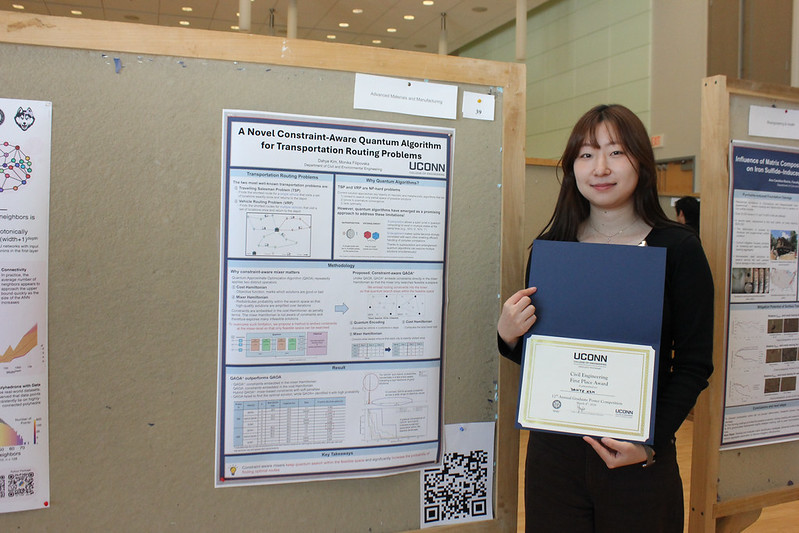
Kim was recognized as one of the Civil Engineering departmental winners for her poster, “A Novel Constraint-Aware Quantum Algorithm for Transportation Routing Problems.” Her research focuses on transportation optimization using quantum algorithms, with particular attention to feasibility constraints that make routing problems especially difficult to solve.
In this work, Kim introduced a constraint-aware variant of the Quantum Approximate Optimization Algorithm, designed to preserve feasibility during quantum evolution. By comparing several formulations across small-scale transportation routing problems, the study demonstrated that embedding feasibility directly into the quantum process can improve performance in constrained optimization tasks. The research highlights the promise of quantum computing approaches for complex transportation and logistics problems.
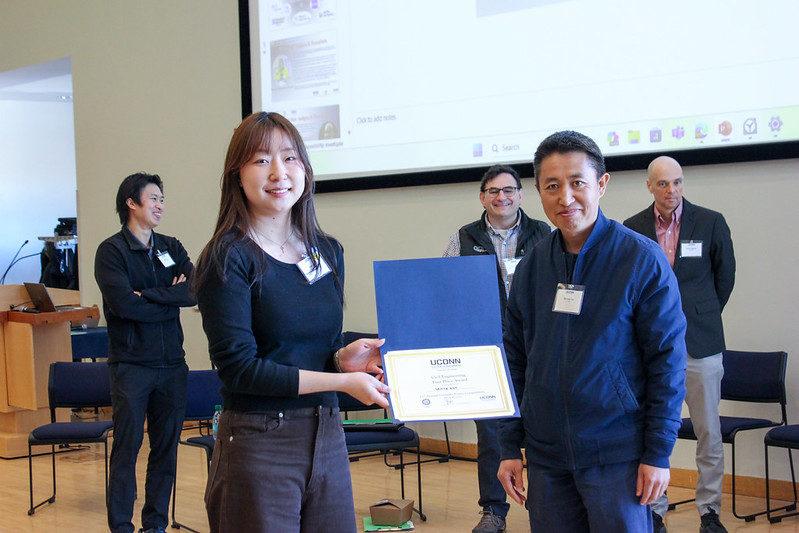
Celebrating Research Excellence Across SoCEE
The School of Civil and Environmental Engineering congratulates Ana Carolina Vieira Rocha, Dahye Kim, and Samuel Rothfarb on these outstanding accomplishments. Their success in the poster competition reflects the high quality of graduate research taking place across SoCEE, as well as the importance of communicating that research clearly and effectively.
Additional photos from the event are available through the UConn Engineering Flickr album.