Master's Degrees
Civil engineers plan and design sustainable infrastructure systems that meet the evolving needs of humanity while maintaining and protecting the natural environment. UConn is proud to offer a variety of advanced degrees in civil engineering. Master's students are strongly encouraged to develop their understanding of civil engineering through in-depth research. Students who pursue research at the master's level often continue on to PhD studies or careers in research and development in government and private institutes.
You can earn a Master's in Civil Engineering with a concentration in Geotechnical Engineering, Structural Engineering, or Transportation and Urban Engineering. You can earn a Master's in Environmental Engineering with a focus in Atmospheric Sciences, Hydrogeosciences and Water Resources, or Contaminant Fate and Resource Recovery.
Master's in Civil Engineering Concentrations:
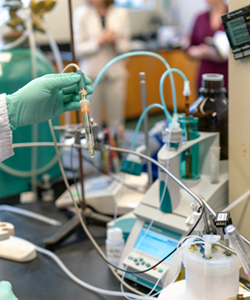 |
Geotechnical Engineering Geotechnical engineers seek solutions to problems related to natural disasters including mudslides and earthquakes, assess site conditions, and design earthworks and foundations. You'll take courses focusing on advanced soil mechanics, earthquake engineering, and foundation design. Facilities within the F.L. Castleman building include the Geophysics Laboratory, Geoenvironmental Laboratory, and the Advanced Geotechnical Laboratory. Faculty research interests include hydrologic modeling, environmental surface chemistry, and engineering site characterization. Learn more. |
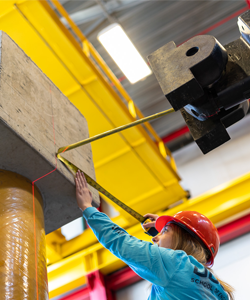 |
Structural Engineering Students pursuing an MS in Civil Engineering with a concentration in Structural Engineering are encouraged to develop their understanding of the subject matter through in-depth research. You'll take advanced courses in reinforced concrete structures, steel structures, and structural analysis, all while benefitting from access to our unique Structures Laboratory and Concrete Laboratory. Faculty members have expertise in areas such as smart structures, accelerated bridge construction, design of resilient structures, structural health monitoring, ultra-high performance concrete, and advanced materials. Learn more. |
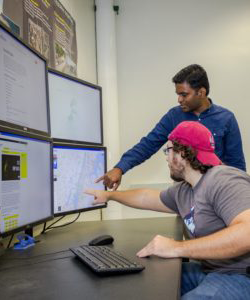 |
Transportation and Urban Infrastructure Students electing a concentration in Transportation and Urban Engineering take specialized courses in transportation planning, street and highway design, and traffic engineering. Faculty research interests include geographic information science, sustainable transportation, highway crash prediction, transportation safety, urban design, and regional planning. You will have access to the high-tech Transportation Systems Laboratory for research, collaboration, and coursework. The transportation research group works in conjunction with the Connecticut Transportation Institute. Learn more. |
Master's in Environmental Engineering Concentrations:
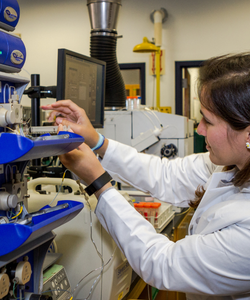 |
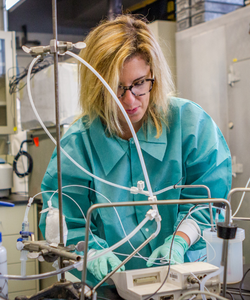
Atmospheric Sciences Students completing this track will gain knowledge in meteorology and atmospheric science, will be able to quantify how species move in the atmosphere, understand climate and its forcings; be able to make atmospheric measurements (meteorological and sampling for gaseous and aerosol pollutants); and obtain knowledge of atmospheric chemical processes. Entering students should have basic quantitative skills (math and statistics) and completed courses in introductory hydrology (large-scale fluid motion) and chemistry. Learn more. |
 |
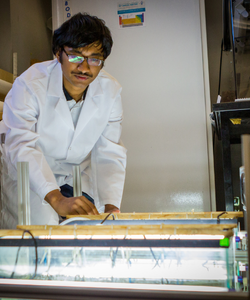
Hydrogeosciences and Water Resources Students completing this track will gain knowledge and skills in measurement and modeling of primary hydrologic processes taking place at the atmosphere-surface interface (precipitation, energy balance), related to overland flows and sediment transport, and to vadose zone and groundwater flow and contaminant transport. Students will acquire experience in hydrologic site characterization and monitoring methods. Entering students should have basic quantitative skills (physics, math and statistics) and completed courses in introductory hydrology and geology. Learn more. |
 |
Contaminant Fate and Resource Recovery The focus of this track is on the characterization and measurement of chemical, biological, physical and climatological processes that control the fate of contaminants in natural and engineered systems. Such processes also form the basis of technologies for the treatment and remediation of contaminants in aquatic systems and prevent contaminants from harming human health. In addition, such processes may constitute the basis for technologies that minimize human impact on the environment, including resource recovery and energy production. Students completing this track will gain knowledge and skills that will allow them to identify, quantify, and ultimately control, the biological, geological and chemical reactive processes in the environment in order to restore/maintain soil and water quality, protect human health and minimize resource utilization. Learn more. |
More information about Master's Programs in Environmental Engineering can be found here.