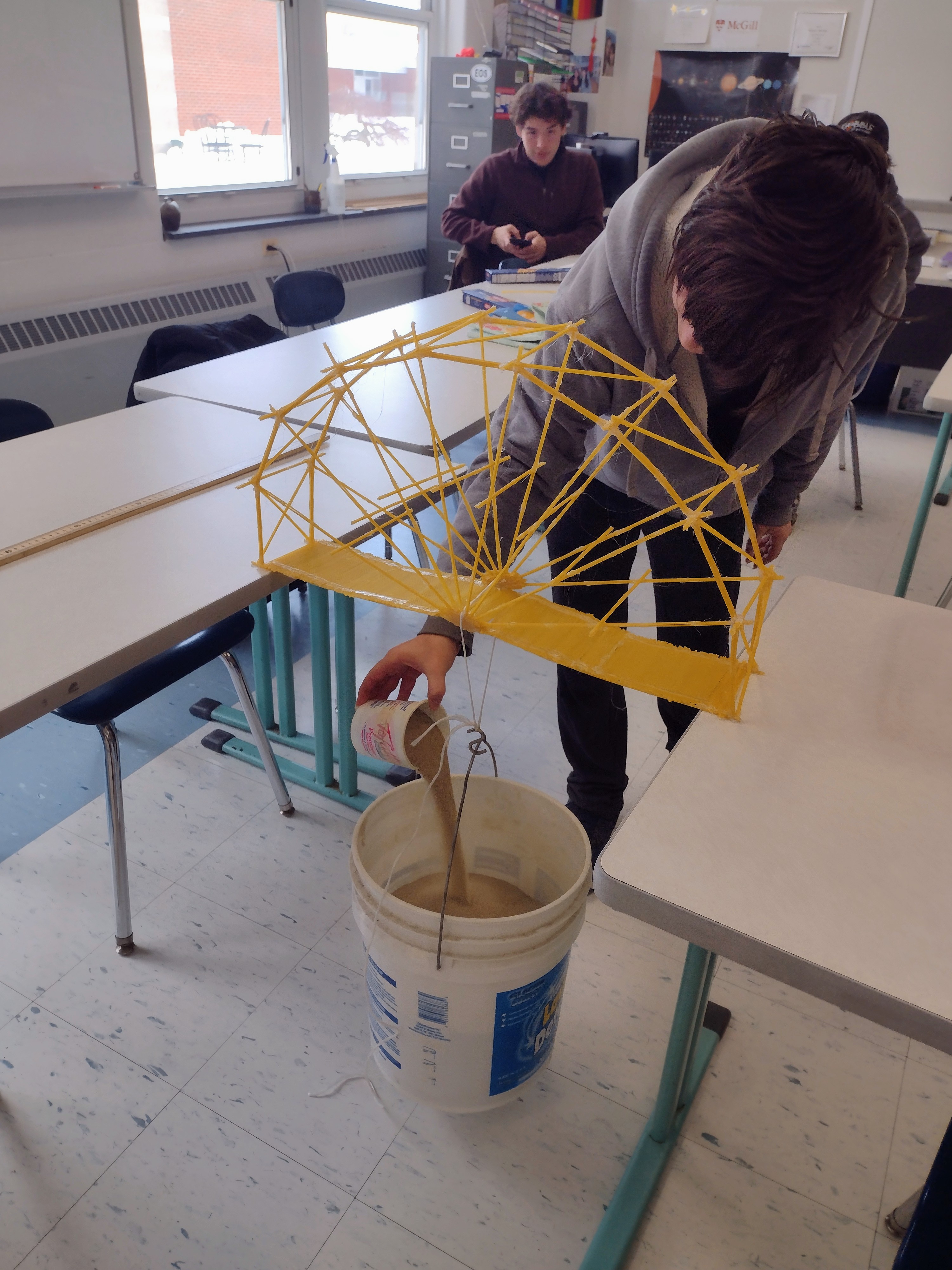
A record-setting pasta bridge at E.O. Smith High School is showcasing the impact of a collaborative effort between UConn Early College Experience (ECE) and the School of Civil and Environmental Engineering.
Students enrolled in CE 2110: Applied Mechanics, a UConn ECE course taught by instructor Raluca Mocanu at E.O. Smith High School, recently designed, analyzed, and tested pasta bridges as part of a hands-on structural engineering project. One student team achieved an impressive milestone when their bridge, weighing just 0.68 pounds, successfully supported 36.8 pounds before failure—an extraordinary 54:1 strength-to-weight ratio.
While the achievement itself is noteworthy, it also highlights the broader educational opportunities made possible through UConn's Early College Experience program and the support of School of Civil and Environmental Engineering faculty.
The Applied Mechanics course introduces high school students to fundamental concepts in structural behavior, force analysis, and engineering design. As part of the bridge project, students utilized SAP2000, a professional structural analysis software platform widely used by engineers to design bridges, buildings, and other infrastructure systems. Through computer modeling, testing, and redesign, students experienced the same engineering processes used in professional practice.
The course has been supported by Sarira Motaref, Professor in Residence and Associate Director of Innovation and Student Success, who has worked closely with E.O. Smith High School and UConn ECE to provide guidance, instructional resources, and engineering expertise.
In correspondence following the project, Mocanu praised the partnership and the resources provided through the program, noting that students were highly engaged and enthusiastic throughout the experience. She also emphasized the value of exposing students to industry-standard software and authentic engineering challenges.
Motaref commended the innovative approach taken by Mocanu, noting that the hands-on bridge project elevated the learning experience by allowing students to apply engineering theory to a tangible design challenge while gaining exposure to professional tools and practices.
The project serves as an example of how collaboration between UConn faculty, Early College Experience instructors, and local schools can create meaningful pathways into engineering. By engaging students with real-world design challenges before they enter college, programs like CE 2110 help cultivate technical skills, critical thinking, and curiosity about engineering careers.
For the students at E.O. Smith, the record-setting bridge represented more than a successful experiment. It demonstrated how engineering principles, creativity, and careful analysis can transform simple materials into remarkably strong structures—and how university-level learning opportunities can inspire the next generation of engineers.
As partnerships between UConn ECE and Connecticut schools continue to grow, experiences like these provide students with an early glimpse into the exciting possibilities of engineering education and practice.