UConn Researchers Receive More Than $1.2 Million for Four CTDOT Transportation Safety Projects
UConn researchers have received more than $1.2 million from the Connecticut Department of Transportation (CTDOT) through its FY27 State Planning and Research (SPR) Program for four projects addressing transportation and infrastructure safety across Connecticut.
The projects bring together researchers from Civil and Environmental Engineering, the Connecticut Transportation Institute (CTI), the School of Computing, and Electrical and Computer Engineering. Their work will examine challenges ranging from culvert inspections in hazardous environments to automated speed enforcement, flashing beacon configurations, and wrong-way driving.
Together, the four awards total $1,207,848 and use approaches including artificial intelligence, drones and robotics, sensor technologies, telematics data, machine learning, and field-based measurements.
Turning Wrong-Way Driving Data into Safety Decisions
Kai Wang, Ph.D., assistant research professor and project manager at CTI, is leading “Wrong-Way Driving Incidents: Analyze Existing Detection Data to Assess the Effectiveness of Specific Countermeasures” (SPR-2722), a $248,374 project running from July 2026 through July 2028.
Although wrong-way driving crashes are relatively rare, they represent a significant safety concern because of their disproportionately severe outcomes. Wang’s team will use real-world data collected through CTDOT’s automated wrong-way driving detection systems to examine the effectiveness of existing countermeasures and better understand what happens when drivers enter roadways in the wrong direction.
Unlike research based only on crashes, the project will use a broader dataset of wrong-way entry events captured by CTDOT detection systems, including events that did not result in crashes.
Researchers will examine measures such as drivers’ self-correction rates, time to correction, distance traveled in the wrong direction, and the severity of wrong-way entries. Statistical and econometric modeling, machine learning, and the Safe System Approach will also be used to identify contributing factors and predict and rank high-risk locations.
The findings will ultimately be incorporated into an interactive web-based decision-support tool intended to help CTDOT prioritize locations, select countermeasures, and guide future safety investments.
Manmohan Joshi, Ph.D., assistant research professor at CTI, serves as co-PI, while Sheikh Muhammad Usman, Ph.D., a postdoctoral research associate at CTI, serves as senior personnel.
“This award provides a valuable opportunity for our team to work closely with CTDOT to address one of the most critical roadway safety challenges in Connecticut. By leveraging real-world wrong-way driving detection data, we hope to better understand why these events occur, identify which countermeasures are most effective, and provide CTDOT with practical, data-driven tools to proactively identify high-risk locations and guide future safety investments. Ultimately, we hope this research will help reduce wrong-way driving events and save lives,” Wang said.
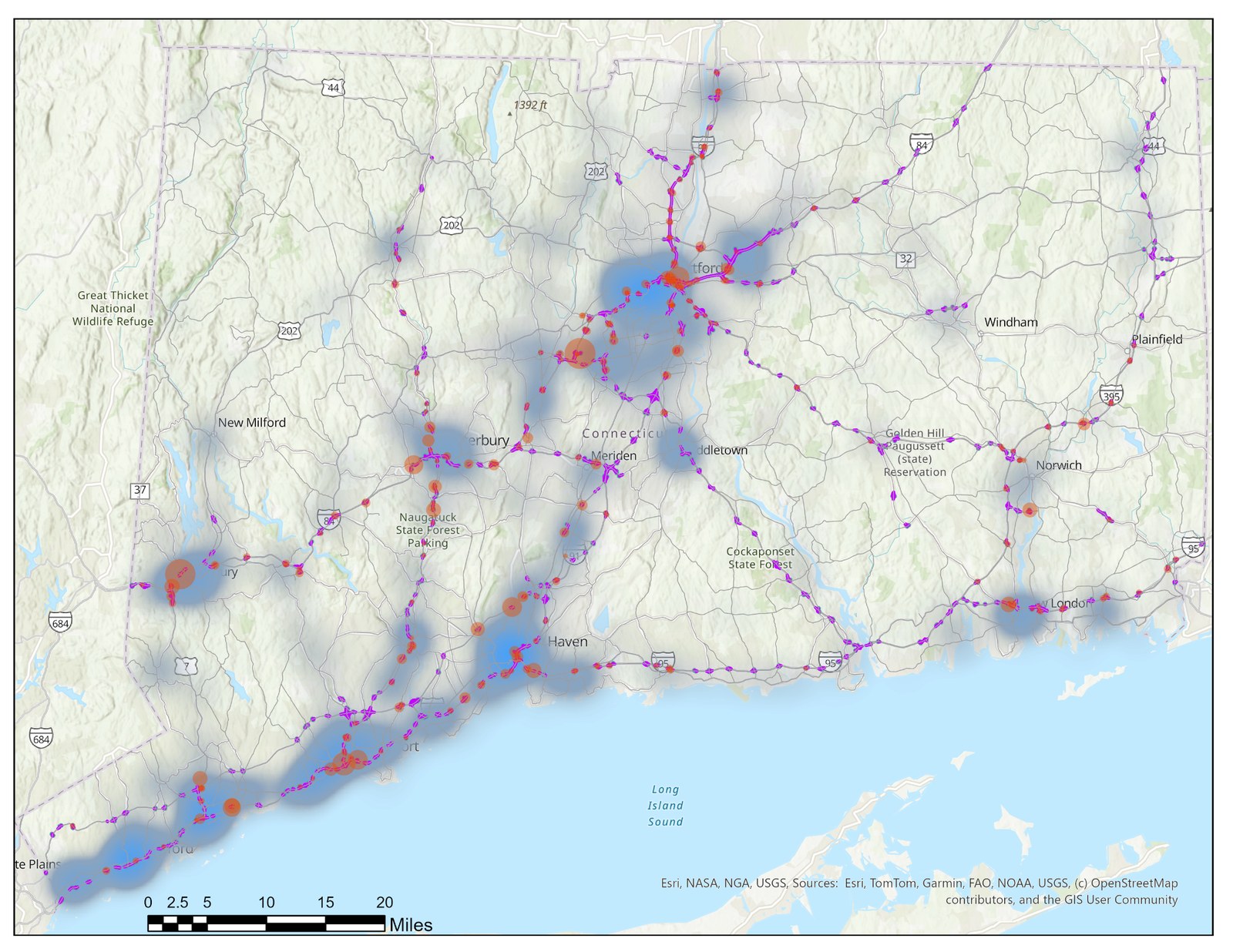
This map shows the locations of all historical wrong-way driving events across Connecticut, along with the number of events recorded at each location.
Using Technology to Make Culvert Inspections Safer
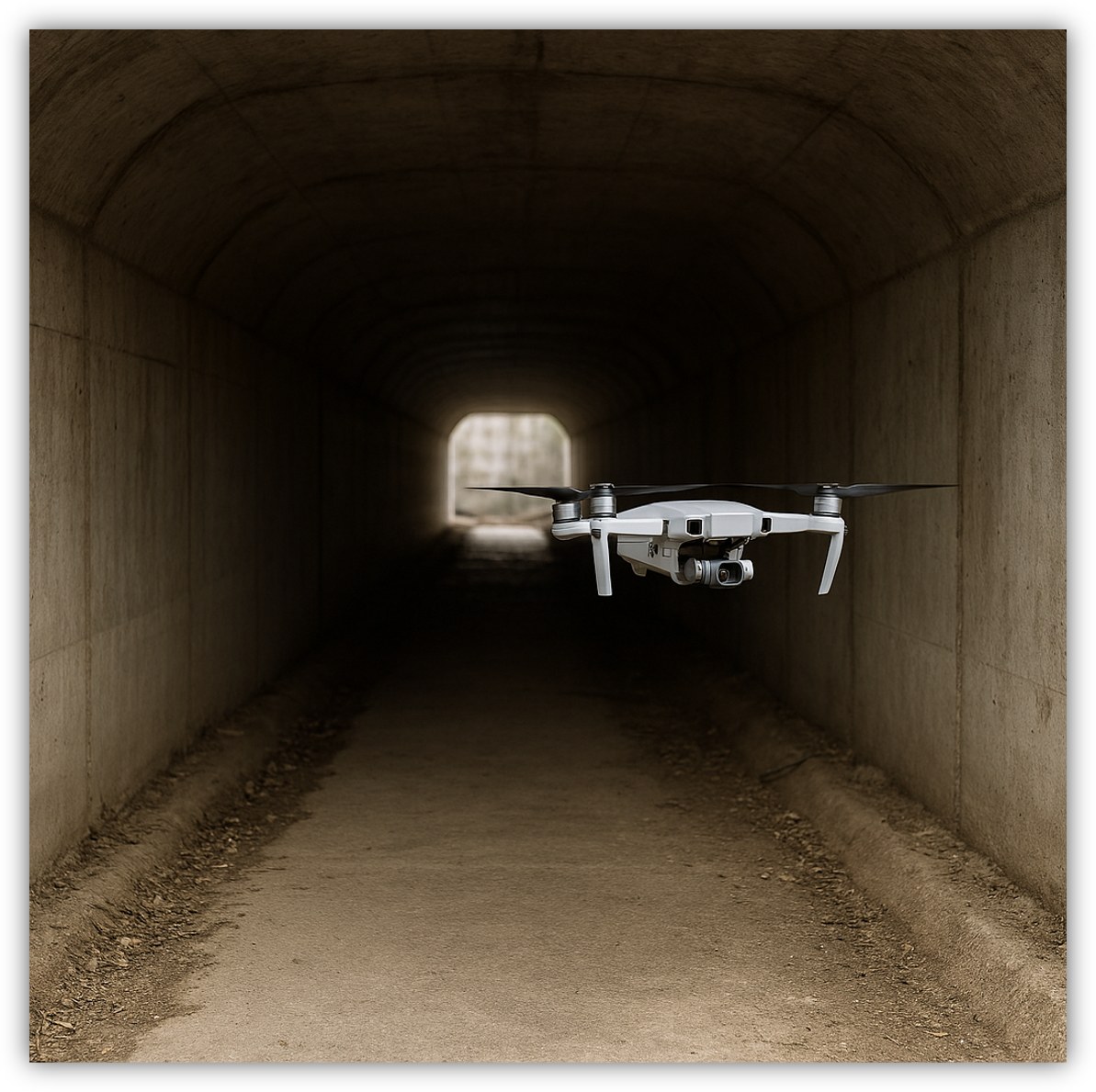 Professor in Residence Shinae Jang, Ph.D., P.E., is leading “Technology-Assisted Culvert Inspections in Confined or Hazardous Areas” (SPR-2753), a $402,137 project running from September 2026 through December 2028.
Connecticut has approximately 11,500 culverts requiring monitoring and maintenance. Inspecting those structures can involve difficult conditions, including dry, partially submerged, and fully submerged environments, as well as hazardous confined-space entry.
The project will develop implementable, vendor-agnostic guidelines for culvert inspection workflows. Researchers will evaluate technologies and inspection platforms, sensors, and processing software while considering their performance, usability, interoperability, and compatibility with CTDOT systems.
The research will also explore standardized operational guidance, AI-driven data processing, flexible inspection systems capable of operating under varying culvert conditions, and field trials to assess the accuracy, reliability, and repeatability of proposed systems under real-world conditions.
Jang is joined by co-PIs Kai Wang, Ph.D., assistant research professor and project manager at CTI; Alexandra Hain, Ph.D., P.E., assistant professor in Civil and Environmental Engineering; Yuan Hong, Ph.D., associate professor in the School of Computing; and Shan Zuo, Ph.D., assistant professor in Electrical and Computer Engineering.
“Connecticut has 11,500 culverts that require close monitoring and maintenance. I am excited to receive funding to advance safer inspection practices for confined culvert systems by leveraging mature technologies, including AI, drones/robotics, and sensor networks, for the safety of our infrastructure and the citizens of Connecticut,” Jang said.
Evaluating Automated Speed Enforcement
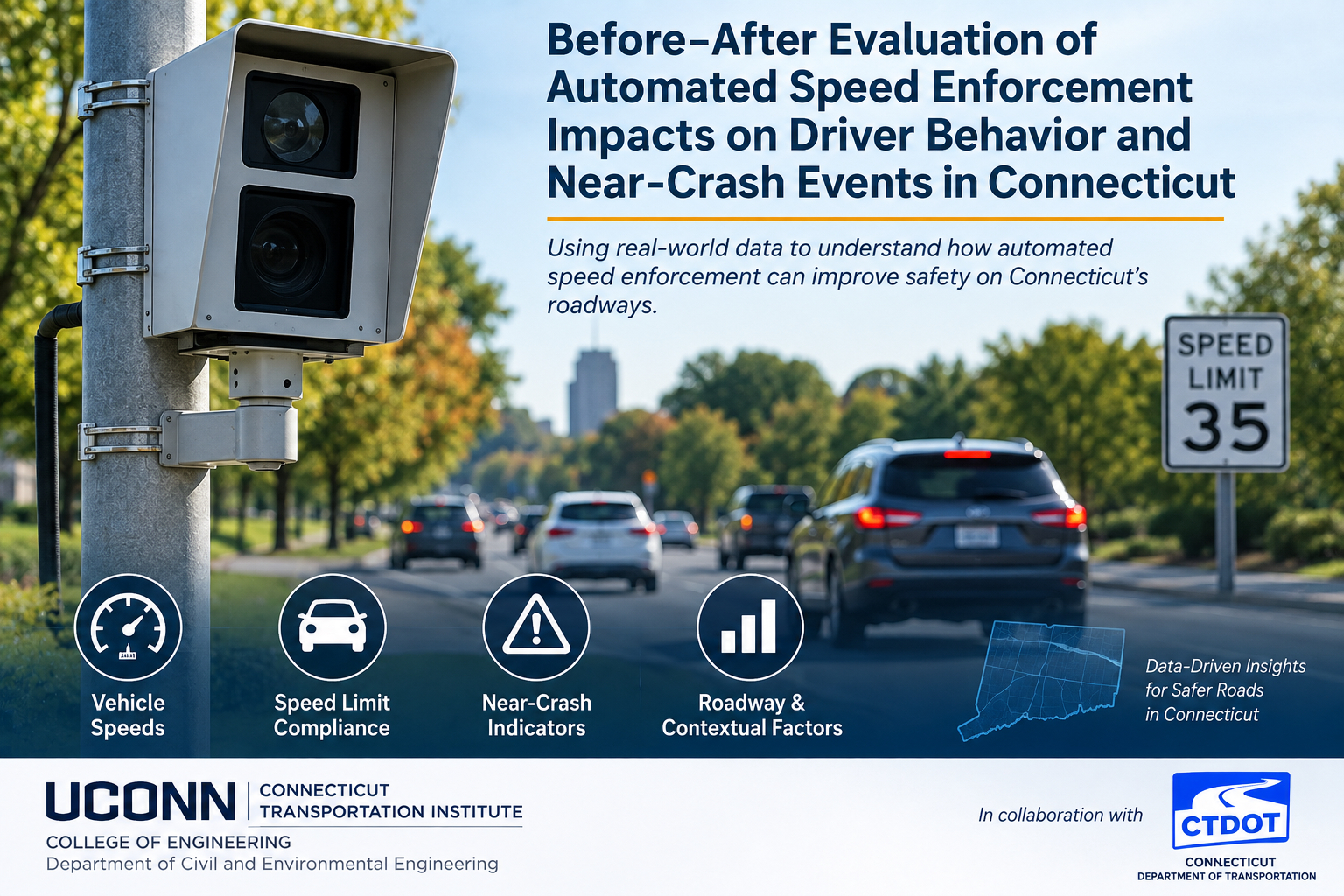
Research Assistant Professor Niloufar Shirani, Ph.D., is leading “Before–After Evaluation of Automated Speed Enforcement Impacts on Driver Behavior and Near-Crash Events in Connecticut” (SPR-2723), a $255,363 project running from July 2026 through July 2028.
The research will evaluate the effectiveness of Automated Speed Enforcement (ASE) in Connecticut through a controlled before-and-after study using high-resolution telematics data.
Researchers will quantify changes in vehicle speeds and compliance with posted speed limits following ASE implementation. They will also examine near-crash and surrogate safety indicators, including hard-braking and rapid-deceleration events.
By studying roadway characteristics, posted speed limits, and land-use contexts, the team aims to provide CTDOT with data-driven, context-sensitive guidance for future ASE implementation.
Shirani is the project PI, with Manmohan Joshi, Ph.D., of CTI serving as co-PI.
Studying Driver Responses to Flashing Beacons
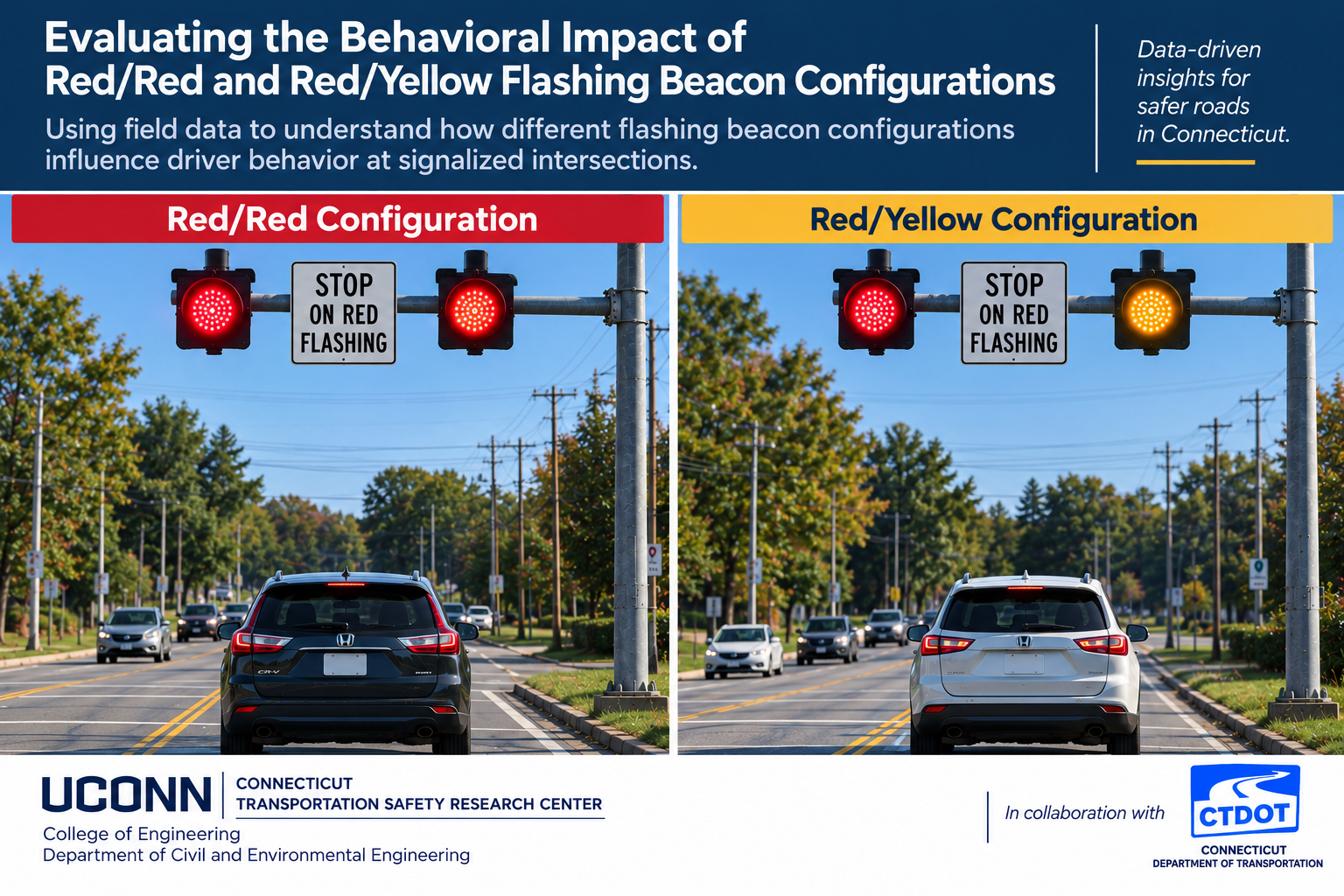
Shirani is also PI of “Evaluation of the Behavioral Impact of Red/Red and Red/Yellow Flashing Beacon Configurations Using Field Data Analysis” (SPR-2721), a $301,974 project running from July 2026 through July 2028.
The study will compare how drivers respond to red/red and red/yellow flashing beacon configurations under real-world roadway conditions.
Using field-based measurements, researchers will examine factors including driver approach speeds, speed reduction, compliance with traffic control expectations, and deceleration behavior across different roadway and intersection contexts.
The project is designed to provide CTDOT with empirical evidence and context-sensitive guidance for selecting and applying flashing beacon configurations. Fatemeh Fakhrmoosavi, Ph.D., of Civil and Environmental Engineering serves as co-PI.
Both of Shirani’s projects involve collaboration with CTDOT, CTI, and Civil and Environmental Engineering. Graduate students Tribhuwan Bhatta, an M.S. student in Business Analytics and Project Management, and Vandana Gupta of the School of Computing have begun working with the research team. The team is also expected to add a Civil and Environmental Engineering Ph.D. student in the spring semester.
“I am grateful for the opportunity to lead these projects in collaboration with CTDOT. Both studies address important transportation safety questions by using real-world data to evaluate changes in driver behavior and safety performance. Our goal is to translate the findings into practical, evidence-based guidance that can support CTDOT’s decision-making and contribute to safer roadways across Connecticut,” Shirani said.
Together, the four projects span infrastructure inspection, driver behavior, traffic control, and roadway safety, while connecting researchers across multiple UConn disciplines with CTDOT. The work will develop and evaluate tools and approaches intended to provide CTDOT with practical evidence to inform transportation and infrastructure decisions across Connecticut.